How do they compare and how can tango DJs make informed decisions?
Digital audio discussions can become surprisingly ideological. Yet tango listening raises slightly different questions than traditional audiophile culture. A milonga is not a laboratory, nor a solitary headphone experience. It is a collective physical situation where sound, movement, memory and emotion continuously interact with one another, where recordings do not simply exist as isolated sonic objects but as part of a shared bodily and emotional environment unfolding between dancers inside the room.
My own supra-experience, however, remained somewhat less obvious.
The other day I witnessed two different DJs playing almost exactly the same Troilo repertoire. The first tanda felt strangely eventless and flat, barely audible emotionally despite technically correct playback. The second time it was as if the Troilo orchestra itself had briefly returned from the heavens to be physically present in the room with us. An extraordinarily strong experience, and one that already tells us something essential: most of the differences that truly matter in tango playback probably do not originate from sampling rates, file formats or audiophile specifications, but from the quality of the sources themselves, the transfers, the restorations, the mastering choices and ultimately the way recorded sound still manages to transmit human presence across time.
Every tango DJ has experienced this strange moment: a recording that sounded perfectly acceptable at home suddenly collapses on a large milonga sound system. Violins become brittle, bandoneóns flatten out, rhythmic tension dissolves and somehow the room itself loses energy. And yet another recording, sometimes transferred from a noisy shellac nearly a century old, suddenly fills the room with an almost tangible presence.
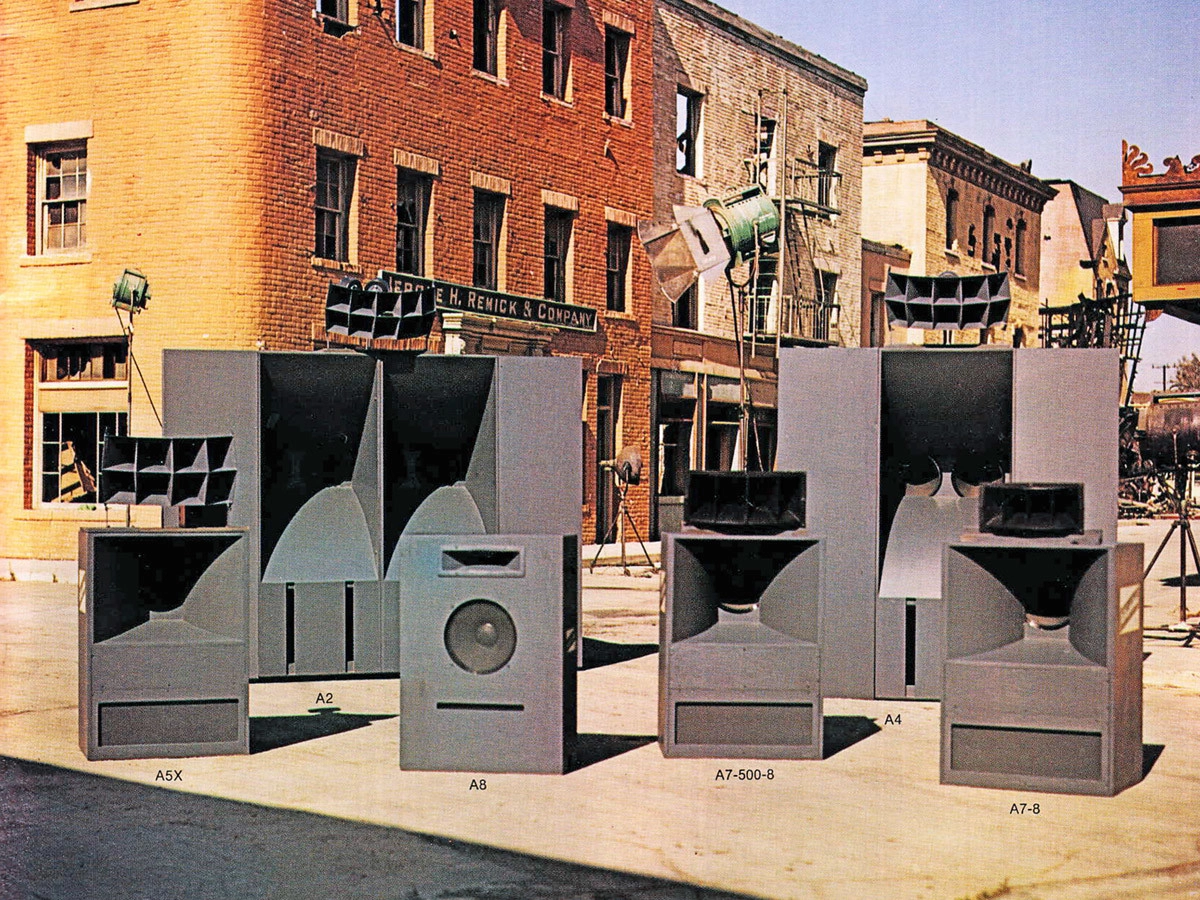
Some time ago I visited a friend for a listening session around a rather impressive vintage hi-fi setup built around modified Altec Lansing loudspeakers equipped with additional supertweeters intended to reproduce ultrasonic frequencies far beyond the traditional audible spectrum. Curiously, whenever the music developed strong high-frequency passages, his two dogs would immediately begin singing along enthusiastically from their favorite position, a sweet spot in the room, apparently deeply moved by the experience. Their relationship to extended frequency response in Beethoven seemed considerably more direct than mine. My own supra-experience, however, remained somewhat less obvious.
The real question is therefore not whether your dog can theoretically hear ultrasonic frequencies above 40kHz, but why certain recordings suddenly come alive in a room full of dancers while others remain emotionally inert despite impressive technical specifications.
And maybe this already says something important about the way audio discussions often evolve today. I know that some DJs in online forums hold very strong opinions about playback chains, audio formats and technical specifications, sometimes almost as if certain formats automatically guarantee a fundamentally superior listening experience. But is it really that simple? What exactly is the relationship between the emotions we experience in a milonga and the technical specifications behind the playback system?
To approach that question seriously, one first has to distinguish between several very different realities that are often confused in online audio debates: restoration workflows, archival preservation, home listening, streaming convenience and real-world milonga playback.
This article is therefore less concerned with proclaiming one format universally superior than with understanding how recordings behave inside real tango environments. Tango DJing is a practical, social and deeply physical art. A tango DJ does not play music into silence. The music enters a constantly moving social space filled with footsteps, breathing, room acoustics, conversations, wooden floors, glasses, clothing textures and shared emotional tension. The point is not isolated sonic purity somewhere under laboratory conditions, but what the orchestra physically does to the room once dancers are inside it.
Of course, another enormously important factor lies outside the immediate scope of this article: the sound system itself. PA quality, loudspeaker voicing, amplifier behaviour, room acoustics, speaker placement and venue characteristics often influence perceived musical quality far more dramatically than subtle differences between digital formats.
Any experienced tango DJ has encountered situations where an excellent recording sounded disappointing on a poorly configured system, while modest source material suddenly became emotionally convincing in a well-balanced room.
But precisely because this subject could easily fill an entire separate article on its own, let us temporarily treat the playback environment as a relatively fixed constant and focus instead on the part DJs more directly control themselves: the audio sources, formats, restorations and playback workflows.
The early trauma of digital audio
When I first listened to a CD in the mid-1980s at Martin’s house, may he rest in peace, I remember being deeply impressed by the apparent purity of the sound. Martin worked as a regional manager for EMI and had become an early adopter of the compact disc, with an already remarkable classical CD collection largely representing the EMI catalogue of the time.
No crackling background noise, no dust, no worn grooves, no gradual deterioration from repeated playback. Coming from vinyl, this felt almost futuristic and nearly like a dream come true.
At the time, depending on pressing quality and especially on how carefully records had been treated, vinyl collections would slowly accumulate more and more surface noise over the years. Sometimes this could become quite frustrating. And to be entirely honest, my own fine-motoric relationship with records at that age probably resembled more that of a frisbee player than that of a careful archivist. It took me years to understand that records actually require a certain degree of gentleness and discipline in handling.
So when the compact disc arrived, many listeners initially experienced it less as “cold digital sound” and more as liberation from the physical fragility of analogue media.
Only later did the criticism emerge. Some early CDs began to sound sterile, harsh or strangely lifeless compared to vinyl records and shellacs. But this was not necessarily because the CD format itself was fundamentally incapable of reproducing music correctly. The problem was often the technological context of the 1980s and early 1990s. DAC converters were still immature, anti-aliasing filters could sound aggressive, remastering techniques were primitive and excessive noise reduction often removed not only hiss and crackle but also part of the orchestra’s natural harmonic structure and room ambience.
Especially in tango, many early CD editions were produced rapidly from already existing tape copies or worn commercial discs, often without deep restoration work or historical research. As a result, many tango listeners associated “digital sound” with a loss of warmth, depth and emotional presence.
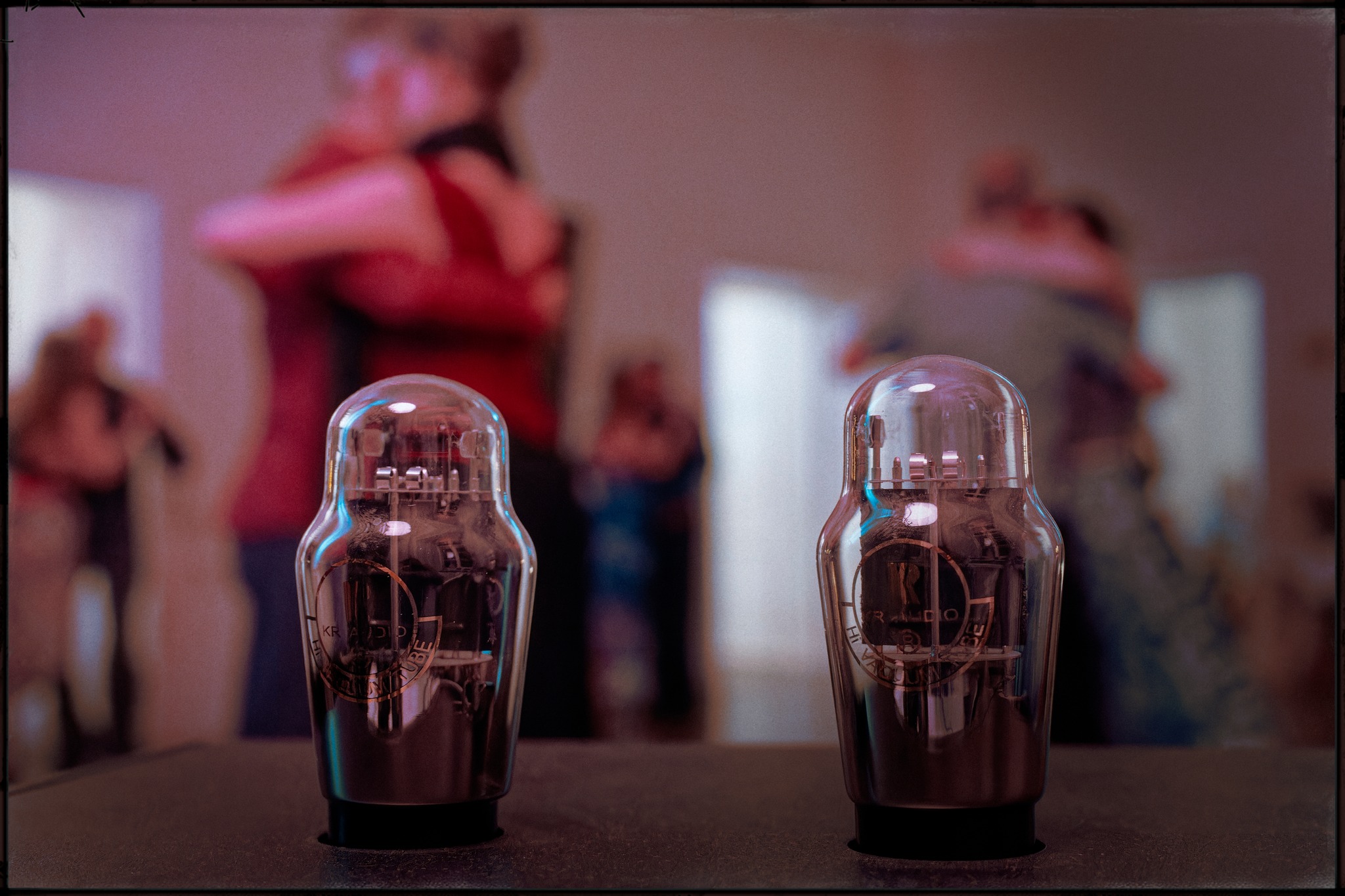
Meanwhile, part of today’s audiophile world seems to be rediscovering older technological philosophies again. Modern delta-sigma DACs dominate the consumer market because they are extremely precise, compact and efficient. Yet at the same time there has been a renewed fascination with so-called ladder DACs or R2R DACs, architectures inspired by earlier Philips converter designs based on discrete resistance networks.
For some listeners these converters are perceived as less analytical, more fluid or somehow more “musical”, even if measurements do not always support dramatic objective differences. Similarly, hybrid amplification chains using vacuum tubes in DAC output stages or preamplifiers have returned in certain audiophile circles, almost as an attempt to reintroduce a form of analogue imperfection back into an otherwise extremely controlled digital signal path.
This tension between precision and warmth already existed long before contemporary HighRes debates. In the 1980s vinyl itself underwent a similar technological evolution with the introduction of Direct Metal Mastering (DMM), where records were cut directly into copper rather than traditional lacquer discs. DMM promised cleaner transients, lower surface noise and greater precision, almost a kind of “high-definition vinyl”. Some listeners loved its clarity and control, while others perceived it as overly analytical or lacking the softer warmth associated with older lacquer cuts. In some ways DMM was not even entirely a futuristic rupture with the past. It also represented a partial return toward older industrial traditions already present during the shellac era, where metal master stages already played a central role in the manufacturing process.
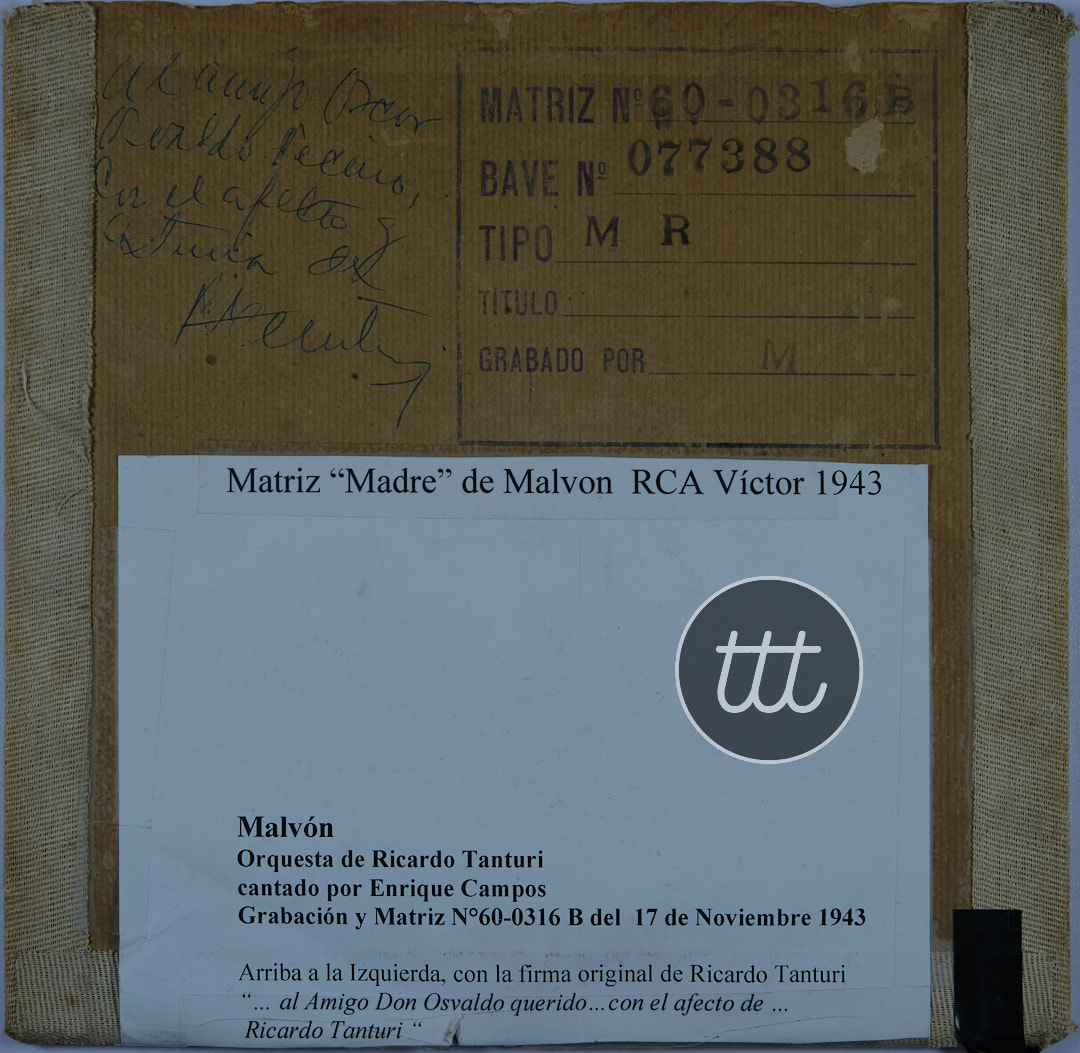
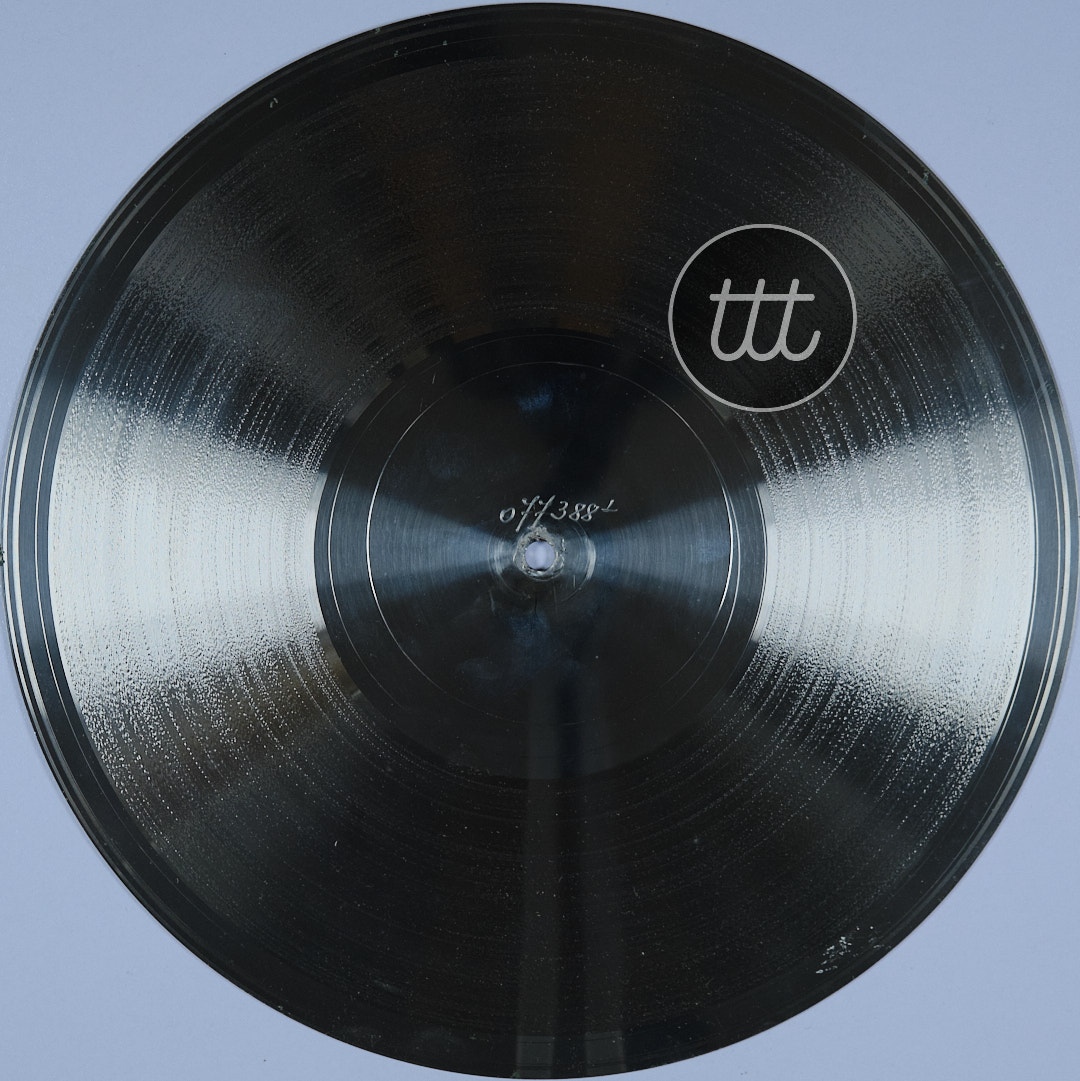
All this also reminds us that we should be careful when thinking about audio technology in purely linear terms, as if the future were automatically superior to the past simply because it is newer.
Technical progress is real, of course. Modern restoration tools, converters and digital workflows can achieve things unimaginable only a few decades ago. But listening itself is not a purely technical act. It is shaped by perception, memory, aesthetics, culture and emotion, and sometimes simply by whether a room suddenly feels alive or strangely absent.
Throughout the history of recorded sound, technologies initially celebrated as breakthroughs were sometimes later criticized for sounding too clinical, too controlled or too detached from the physical texture of music. At the same time, older technologies once abandoned as obsolete are periodically rediscovered and reinterpreted as more “musical”, “organic” or emotionally engaging.
Audio history therefore does not evolve along a simple straight line. It moves more like a pendulum between precision and imperfection, control and texture, analysis and emotion.
Tango listeners may intuitively understand this better than many others. We continue to dance recordings made under severe technical limitations, sometimes nearly a century ago. Yes, they often contain surface noise to varying degrees, depending on the condition of the transferred shellacs and the philosophy of the restoration itself. But many of these recordings also transmit something remarkably unique that modern productions often struggle to recreate.
Most tango recordings of the golden age were essentially direct-to-disc performances: orchestras playing live from beginning to end, musicians gathered physically in the same room, balancing themselves acoustically around a small number of microphones, often under enormous time pressure. In many cases, first takes were released commercially.
What these recordings may lack in technical perfection, they often compensate through immediacy, tension, collective interaction and an almost physical sense of presence. One does not merely hear the orchestra, one sometimes has the impression of witnessing a living moment being fixed onto material in real time. In a certain sense this recalls the famous “ça-a-été” described by Roland Barthes in his reflections on photography: the strange emotional awareness that what we perceive is not a simulation but the trace of something that truly existed in front of the recording apparatus at a specific moment in time.
Modern production frequently constructs performances layer by layer through editing, overdubbing and postproduction, while many golden-age tango recordings document irreversible collective decisions unfolding in real time.
This may also explain why so many historic tango recordings continue to move listeners so deeply despite their technical imperfections. Their fragility itself becomes part of the experience. The crackle remains, the shellac noise remains, yet somehow the orchestra still cuts through time.
Restoration as interpretation
A fascinating and sometimes disturbing aspect of tango restoration is that the very same historical recording can exist emotionally as several completely different recordings while technically still being “the same take”.
When listening to transfers produced during the 1960s, 70s and 80s, before contemporary digital restoration tools became available, one can already perceive very strong added artifacts and interpretative interventions. Artificial reverberation was frequently added to historic recordings to varying degrees of intensity, partly because dry shellac transfers were often perceived as too narrow or acoustically primitive for contemporary listeners.
The result was paradoxical. The orchestra suddenly appeared to inhabit a much larger space, and part of the surface noise became masked almost incidentally by the added ambience. Yet at the same time much of the recording’s immediacy, detail and physical presence disappeared. The musicians no longer seemed to play together inside a tangible room but instead inside an abstract acoustic cloud. Similar problems sometimes appeared later in artificially widened pseudo-stereo remasters where the orchestra lost part of the remarkable solidity and spatial coherence many original mono recordings still possess.
Strong pitch deviations were also frequently introduced during this period, sometimes intentionally, sometimes accidentally through transfer chain inaccuracies. Recordings became faster, brighter and superficially more energetic. But changing playback speed also changes tonal center, orchestral colour and emotional character.
The intention of the orchestra itself could therefore become subtly transformed. A darker, suspended Troilo passage could suddenly become nervous and hurried. Rhythmic gravity weakened, phrasing changed and the emotional architecture of the performance shifted almost imperceptibly toward restlessness.
Contemporary retransfer projects returning directly to original shellac discs can therefore feel genuinely revelatory. One does not merely recover cleaner sound. One often rediscovers the orchestra’s original temporal breathing, tonal balance and emotional weight, but also entire layers of orchestral detail that had remained buried or nearly inaudible for decades.
This is also why higher internal resolutions such as 96kHz/24bit can make considerable sense during restoration workflows themselves. Spectral repair, de-clicking, EQ processing, pitch correction and oversampling operations all benefit from additional processing headroom even if final playback distribution later returns to standard CD-quality formats.
Restoration is therefore never purely technical. It always also becomes an interpretation of musical presence across time. Sometimes a tiny EQ decision or a slight pitch correction can completely change the emotional gravity of a recording.
A practical listening experiment that tango DJs, and dancers as well, can easily perform is to focus not on overall loudness or apparent brilliance, but on instrumental separation inside the orchestra.
Can you clearly distinguish the double bass from the left hand of the piano? Can you follow the internal dialogue between bandoneóns and violins? Do the rhythmic accents remain intelligible when the full orchestra enters simultaneously? Do transients strike with physical immediacy, almost hitting the room, or do they feel softened and collapsed into themselves? Or does everything gradually dissolve into a kind of undifferentiated sound soup?
Differences in source quality often become perceptible precisely here, restoration philosophy and transcoding damage become much more perceptible than abstract discussions about sampling rates. Poorly preserved dynamics, excessive compression, aggressive denoising or repeated lossy transcoding tend to blur orchestral structure. Instrumental contours soften, transient attacks lose precision and the internal architecture of the arrangement becomes harder to perceive.
Yet tango orchestras were extraordinarily sophisticated constructions. Figures such as Aníbal Troilo, Osvaldo Pugliese and Horacio Salgán, together with the arrangers surrounding their orchestras, developed highly complex internal balances between rhythmic foundation, melodic phrasing and orchestral colour. Even dancers without technical audio knowledge often perceive these differences instinctively through the body itself. The walk becomes more grounded, pauses gain tension and the embrace seems to breathe more naturally with the orchestra when the internal structure of the music remains clear and alive.
A restoration does not exist only as an isolated audio object under laboratory conditions, but as part of a shared physical experience unfolding inside a room full of dancers.
In this context one should also be careful not to approach historic tango recordings with the idea that they somehow need to be transformed into modern digital productions. The objective of restoration is not to make a 1937 shellac sound like a contemporary studio recording, nor to eliminate every trace of background noise at any cost. Surface noise, hiss and material imperfections are inseparable from analogue recording history to varying degrees. Of course excessive noise can become distracting, and careful restoration work can significantly improve listenability. But an obsessive focus on noise removal can easily shift attention away from far more important musical questions, or even create entirely new problems inside otherwise excellent transfers.
Aggressive denoising often removes not only noise but also harmonic information, room texture, transient detail and part of the orchestra’s natural presence. Violins become strangely synthetic, bandoneóns lose their breath-like texture and the overall recording may begin to sound sterile or emotionally flattened.
Another important aspect often forgotten in online restoration debates is that many DJs and collectors today evaluate historic recordings through highly resolving headphones or nearfield studio monitors under extremely controlled listening conditions.
But a milonga is a completely different acoustic reality. Music in a tango event circulates through large PA systems, reflective rooms, moving bodies, conversations, wooden floors and constantly shifting collective acoustics. Under these conditions a considerable part of low-level hiss and broadband surface noise is often naturally masked or simply absorbed into the overall acoustic environment, while what remains perceptually important is usually not microscopic spectral cleanliness, but the orchestra’s rhythmic structure, harmonic richness, dynamic breathing and bodily energy.
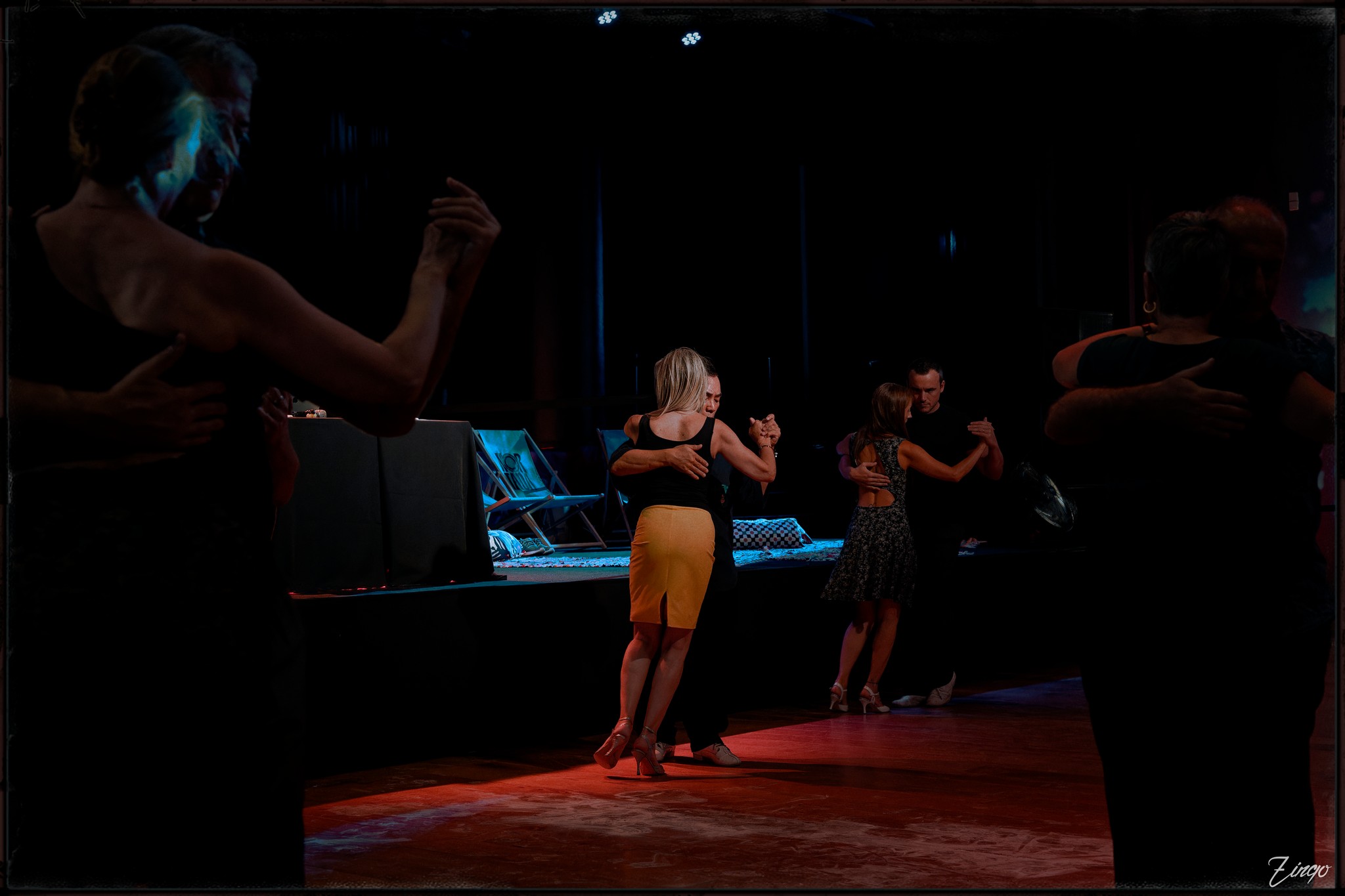
Certain aggressively denoised restorations therefore sound superficially “clean” in isolated headphone listening can paradoxically feel weaker, flatter or less alive during actual social dancing. Meanwhile a slightly noisier transfer preserving the orchestra’s internal texture and transient vitality may suddenly become extraordinarily convincing once projected through a real milonga sound system.
Tango listening is therefore deeply contextual.
A restoration does not exist only as an isolated audio object under laboratory conditions, but as part of a shared physical experience unfolding inside a room full of dancers. And dancers are often much better listeners than they themselves think. Tango sound quality is fundamentally relational rather than absolute. It emerges between orchestra, restoration, playback chain, room acoustics, dancers and collective perception rather than existing as an isolated technical property inside the recording itself.
MP3, streaming and musical circulation
For many tango DJs of the early internet era, MP3 was not initially an audiophile question at all. It was a revolution of circulation. Suddenly rare orchestras, forgotten singers and impossible-to-find recordings could travel internationally within minutes rather than years.
Entire generations of tango dancers discovered orchestras through forums, mailing lists, peer-to-peer exchanges and later Facebook groups long before streaming platforms began integrating historical tango catalogues.
MP3 therefore undeniably contributed to the democratization of tango culture, even if this often came at the expense of sonic quality.
The problem is not merely that MP3 is lossy. The more serious issue is cumulative transcoding. A recording compressed repeatedly across several generations gradually loses articulation, transient precision and internal orchestral structure. Bandoneóns become grainy, violins flatten out and rhythmic tension softens.
This becomes especially problematic on platforms such as YouTube, where audio is often already uploaded from compressed sources before being recompressed yet again into new streaming formats. In many cases the resulting signal effectively becomes “lossy on top of lossy”.
As a discovery tool YouTube remains extraordinary. It functions as a gigantic collective musical memory and preview platform. But for serious milonga playback it should generally remain precisely that: a preview medium rather than a definitive archival source.
This is also where projects such as tango-dj.at become particularly valuable. Their prelisten functionality allows DJs to identify orchestras, compare versions and explore repertoire while still orienting themselves afterward toward higher quality sources and restorations.
Streaming services introduce a different paradox. We have access to more tango music than ever before, yet often with less knowledge about provenance, transfer quality and restoration history. Most streaming platforms do not produce new archival tango transfers themselves. In the overwhelming majority of cases they simply license and redistribute already existing catalogues provided by labels, distributors or aggregators, often relying on older CD masters transferred decades ago under very different restoration philosophies.
As a result, the presence of a recording on a modern streaming platform should not automatically be interpreted as evidence of archival quality or historical accuracy. The real restoration work, retransfers from original shellacs, pitch correction, stylus selection, noise management and preservation of orchestral articulation, is still often carried out by independent restoration engineers, collectors and specialized historical projects rather than by the streaming platforms themselves.
There is also another reason why streaming platforms are generally not ideal for professional milonga playback, even when they offer local caching or offline modes.
A tango DJ environment is fundamentally different from casual home listening. During a milonga one needs stable, predictable and uninterrupted playback over many consecutive hours. Streaming applications, however, remain software ecosystems primarily designed around consumer convenience rather than long-form live performance reliability.
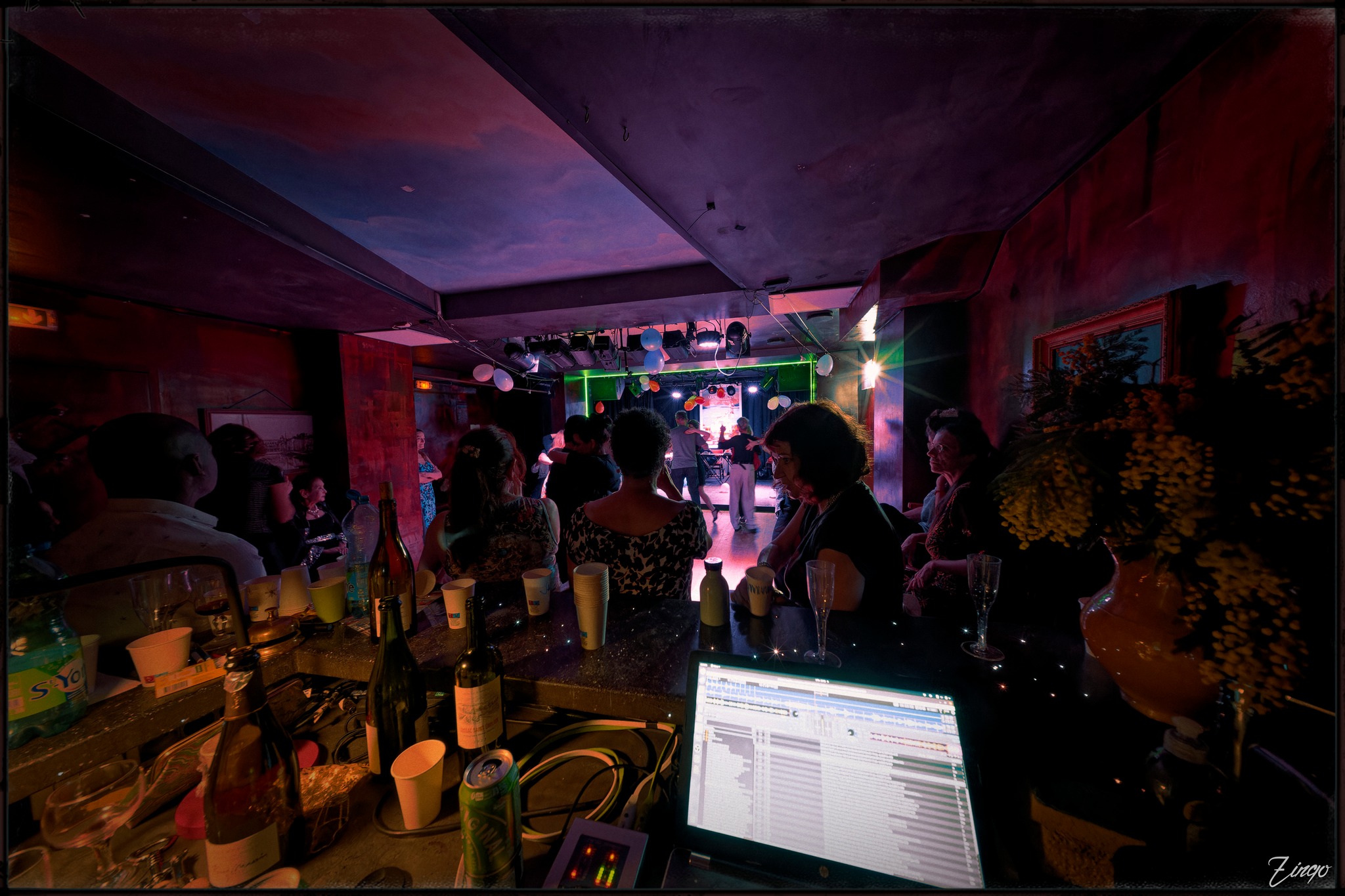
Background synchronization, DRM verification, sudden software updates, account logouts, network checks, metadata refreshes, playlist inconsistencies or buffering behaviour can all potentially introduce instability into a live DJ situation. Even small interruptions become highly visible in a tango environment because the entire room is collectively synchronized around the continuity of musical flow.
There is also the question of long-term control. Streaming catalogues constantly change according to licensing agreements. Recordings disappear, alternate masters silently replace older versions and metadata can change without warning. A DJ who carefully constructs tandas over years therefore usually prefers maintaining a locally curated and archived collection whose sonic characteristics remain stable and known.
For similar reasons, dedicated DJ software tends to function more reliably with locally stored audio files than with streaming integrations layered on top of additional decoding, authentication and synchronization systems. In practice, many experienced tango DJs therefore continue to prefer carefully organized local libraries in open formats such as AIFF, WAV or FLAC, even while using streaming platforms extensively for discovery, exploration and repertoire research.
Milongas are long. The body sometimes arrives at conclusions long before theory even understands the question.
Streaming platforms also normalize loudness aggressively. This creates another subtle but important transformation in musical perception.
Historic tango orchestras depend profoundly on dynamic breathing. Tension accumulates and releases. Rhythmic pressure alternates with suspension. Instrumental density expands and contracts continuously. Strong loudness normalization and dynamic range compression tend to flatten these movements into a permanently saturated present. Initially such masters may appear clearer, louder or more modern during short listening comparisons. Yet over extended periods they often become strangely exhausting.
The orchestra no longer breathes naturally. Musical events lose contrast. Silence itself becomes compressed. Dancers may unconsciously fatigue more rapidly because the music no longer provides sufficient dynamic relief or emotional suspension. This becomes particularly important in tango because milongas often last many consecutive hours. Sound quality is therefore not merely a question of isolated fidelity, but also of long-term bodily and emotional sustainability.
This may also explain why discussions around blind ABX testing and perceptibility sometimes become more complicated in real tango environments than they initially appear under laboratory conditions. Short analytical listening tests may correctly demonstrate that many listeners struggle to distinguish between formats under tightly controlled comparison situations. Yet social dancing unfolds across radically different temporal and embodied scales.
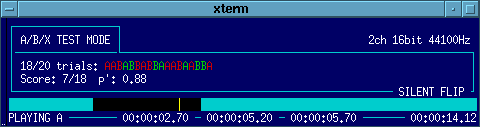
A milonga is not a thirty-second headphone test between isolated audio fragments. It is an extended immersion involving movement, tension, fatigue, breathing, emotional accumulation and bodily synchronization over many consecutive hours. Under these conditions, subtle differences in dynamics, articulation, compression behaviour or listening fatigue may become perceptible less as consciously identifiable “sound differences” than as gradual shifts in energy, concentration, emotional openness and the way dancers inhabit the music itself.
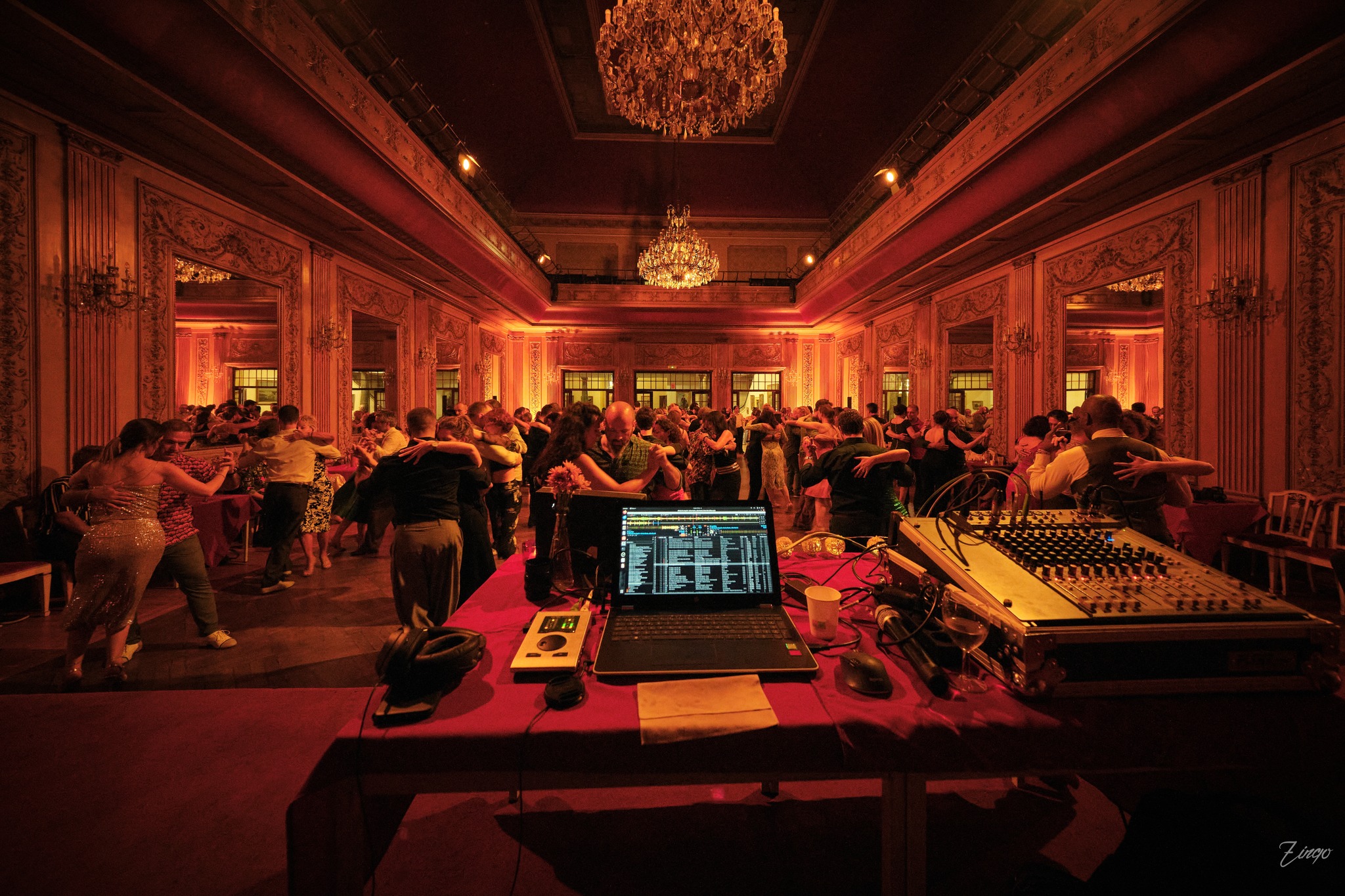
Certain historic transfers may initially sound less spectacular during quick comparisons while remaining considerably more pleasant, intelligible and emotionally alive across an entire night of dancing. Milongas are long. The body sometimes arrives at conclusions long before theory even understands the question.
Formats in practice
From a purely practical point of view, standard CD-quality audio, 44.1kHz/16bit, still remains one of the most sensible compromises for tango DJ playback. Properly mastered, it already captures essentially the complete audible spectrum while remaining computationally efficient, stable and universally compatible. Christopher Montgomery from Xiph.org formulated this pragmatic engineering position particularly clearly in his well-known reflections on digital sampling theory.
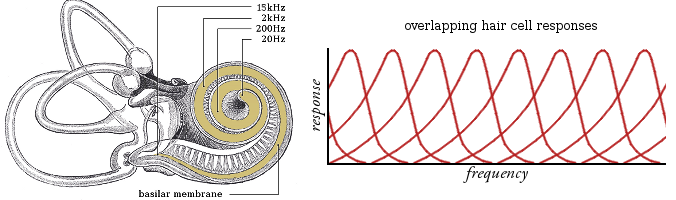
Once one understands how strongly tango depends on temporal coherence, articulation and collective rhythmic perception, the practical stability of the digital playback chain suddenly becomes far more important than abstract specification races.
Before dreaming too much about eventual benefits of HighRes audio and ultrasonic sound reproduction, it is perhaps worth taking a step back and looking concretely at the actual playback chain a contemporary laptop tango DJ must control in order to maintain a stable and coherent digital bitstream throughout an entire night of tandas.
We have already discussed some of the shortcomings and material fragilities of analogue sound reproduction. But digital audio has its own problems as well, even if they are often less immediately visible.
Timing errors, jitter, dropped samples, unstable USB communication, overloaded CPU scheduling, badly optimized drivers or aggressive power-saving mechanisms can all potentially affect playback stability. Unlike occasional shellac surface noise, these problems may not even manifest themselves continuously or dramatically. They often appear only under specific real-time conditions: a crowded milonga, large music libraries, external DACs, waveform analysis, Bluetooth interference, projector outputs, Wi-Fi synchronization or multiple background applications competing simultaneously for system resources.
What makes such problems particularly insidious is that listeners often perceive them less as clearly identifiable defects than as a vague sensation that something in the music no longer feels entirely stable, grounded or emotionally convincing. Rhythmic articulation becomes subtly nervous, orchestral separation weakens, transients lose precision and long listening sessions become strangely tiring without the listener necessarily understanding why.
In tango this can matter enormously because the music depends heavily on temporal tension, suspension and collective rhythmic coherence. Even small instabilities inside the digital playback chain may subtly affect how dancers physically synchronize themselves with the orchestra and with each other.
The fragility of digital playback environments sometimes reveals itself in unexpectedly comic ways. Years ago at a local milonga, during a Canaro tanda, a DJ suddenly received an incoming Skype call directly through the sound system. For a few surreal seconds the room genuinely seemed to wonder whether Canaro himself was perhaps calling in from the au-delà.
At another international event, a DJ had apparently forgotten to renew his VirtualDJ licence. Every thirty minutes the software would abruptly interrupt the atmosphere by loudly announcing the words “Virtual DJ!” through the PA system like some strangely enthusiastic digital parrot periodically emerging from inside the tanda.
Beyond the humor, such moments also remind us how many invisible technological layers contemporary laptop DJs continuously depend upon. Operating-system notifications, messaging applications, wireless synchronization, licensing systems, background updates and competing audio processes all potentially interfere with the continuity of musical flow if not carefully controlled.
A particularly interesting example is the open-source DJ software developed by the Mixxx community. Beyond supporting Linux, Mixxx also runs on Windows and macOS, even though these systems do not traditionally rely on realtime kernels in the same way. Mixxx is especially interesting because it exposes technical playback information such as dropped audio buffers while taking advantage of realtime processing and optimized I/O priorities when available.
In my own experience, one reason the DJ software Mixxx works particularly well is precisely because it follows a radically different philosophy. As free and open-source software, Mixxx avoids many of these external dependencies while handling operating-system sounds, alerts and intrusive background interruptions particularly effectively. Combined with stable realtime-oriented audio workflows, this can make an enormous difference during long milonga situations where reliability itself becomes part of the listening experience.
My own preference would generally go toward operating systems capable of offering at least partially preemptive or realtime-oriented kernel behaviour, as found in many Linux distributions. Combined with playback software designed with realtime audio priorities in mind, this can significantly reduce timing instability and improve overall playback robustness.
And one should perhaps not underestimate another important aspect of open-source software in this context: long-term autonomy. If a proprietary platform disappears, changes licensing conditions or suddenly withdraws access, DJs may find themselves locked out of tools or workflows they depended upon for years. Open-source software cannot entirely eliminate technological fragility, but it considerably reduces dependency on external corporate decisions. In the long run this also becomes a form of sustainability, continuity and freedom from lock-in.
Of course software is only part of the equation. A decent DAC, stable USB communication and properly constructed audio cabling remain equally important. Fortunately, the general quality threshold of affordable DACs has improved enormously during the last years. One no longer needs astronomically priced audiophile hardware in order to achieve remarkably transparent playback. Older DACs designed during earlier generations of consumer digital audio can sometimes still benefit from replacement. Improvements in clock stability, converter design, noise isolation and USB implementation have become quite substantial even in relatively modest price ranges.
As always, however, the goal should not be technological fetishism for its own sake. Beyond a certain threshold one often buys not only marginal sonic refinement, but also build quality, electrical stability, robustness and long-term reliability. And in a tango DJ context, reliability itself is already an essential part of sound quality.
Another practical aspect often underestimated by newer DJs is format consistency within the music library itself.
Many modern DJ applications internally convert or buffer audio into a unified playback pipeline in real time. When constantly switching between very different formats, MP3, FLAC, AIFF, AAC, streaming codecs or externally synchronized cloud files, the software may need to perform additional decoding, transcoding, waveform generation or cache management operations during playback. On powerful modern machines this is usually manageable, but in long milonga situations involving large libraries, continuous searching, external sound cards, Bluetooth interference, projector outputs or multiple background processes, unnecessary format complexity can still become a source of instability.
For this reason many experienced DJs prefer keeping their primary playback libraries relatively homogeneous and predictable. Beyond sound quality itself, consistency reduces CPU overhead, simplifies waveform caching and generally leads to more stable long-duration playback behaviour.
Simple, well-supported formats such as AIFF, WAV or FLAC at standard CD-quality resolutions often remain the most pragmatic solution for tango DJing. High bitrate MP3 can still perform surprisingly well in many real-world milonga situations, especially when encoded carefully from good source material. The real problem usually begins less with MP3 itself than with repeated transcoding, poor source provenance and cumulative compression artifacts gradually eroding orchestral articulation and dynamic coherence.
There is also a certain irony in contemporary audio culture. Some listeners debate minute differences between extremely high-resolution audio formats while simultaneously transmitting the final signal through heavily compressed Bluetooth codecs. None of this makes Bluetooth unusable, modern codecs improved enormously, but it once again reminds us that isolated technical specifications rarely determine musical experience by themselves. Audio reproduction always functions as an entire chain whose weakest elements often become more significant than theoretical maximum resolutions elsewhere in the system.
An aspect often overlooked in format discussions is long-term archival stability itself. Tango DJs do not merely consume music temporarily, they gradually construct personal archives over decades. A DJ collection is often less comparable to a playlist than to a constantly evolving musical memory system in which recordings, metadata, tanda logic, historical associations and personal listening experience slowly accumulate into a form of cultural memory.
In this context open and well-documented formats become important not only for sound quality but also for long-term independence. Proprietary ecosystems, DRM restrictions, cloud dependencies or closed streaming infrastructures may function comfortably in the short term while remaining fragile over longer historical timescales.
This is partly why real open-source formats such as FLAC became so important in archival communities. The objective is not only efficient lossless compression, but the possibility of preserving musical material independently from specific vendors, subscriptions or platforms.
Ironically, tango culture itself already understands the fragility of disappearing media extremely well. Entire orchestras survived only through private collectors, forgotten shellacs or accidental archival preservation.
Metadata may appear secondary compared to audio quality itself, yet for tango DJs it becomes absolutely fundamental because tango recordings rarely function as isolated tracks. A tanda is not a random playlist assembled by algorithmic coincidence. They exist inside networks of orchestras, singers, recording dates, stylistic periods and emotional relationships that continuously influence musical interpretation and tanda construction.
Metadata on non-specialized platforms can also be incomplete, inconsistent or entirely absent. Missing or incorrect recording dates, for instance, may seem harmless at first glance while profoundly affecting historical coherence during tanda construction. A DJ unknowingly mixing recordings from radically different orchestral periods may unintentionally destroy stylistic continuity, tonal evolution or rhythmic consistency inside the tanda itself.
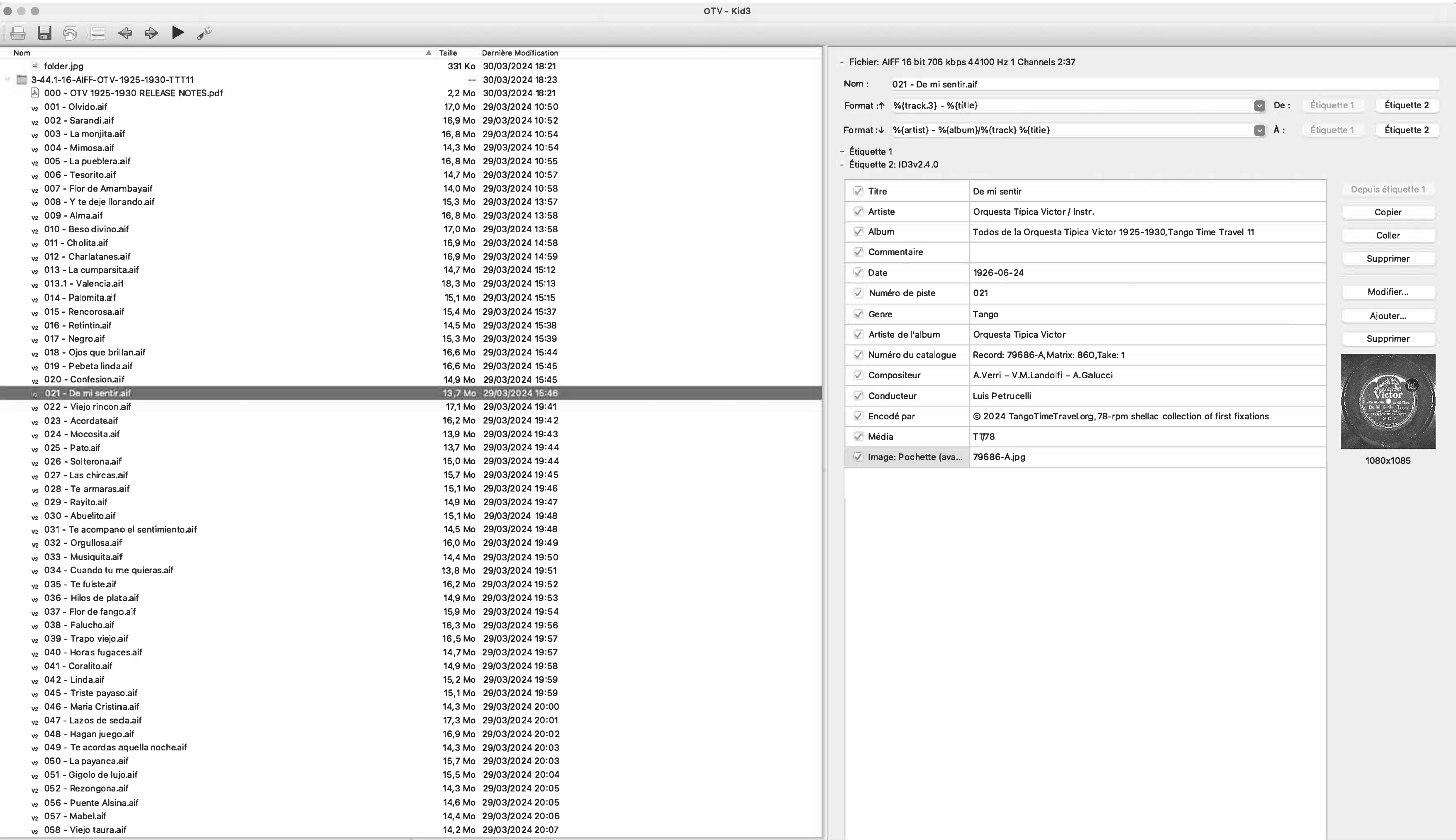
A tango recording is never merely a sound file. It carries a network of relationships: orchestra, singer, recording date, composer, lyricist, genre, historical period, recording label and countless subtle contextual associations influencing tanda construction. Poor metadata transforms musical archives into chaos. Good metadata, by contrast, allows orchestras and historical periods to remain intelligible across time.
Digital tango culture is therefore not only preserving sound, but also preserving musical memory structures.
The human ear, and perhaps even more the human mind, may ultimately remain one of the most sophisticated noise-reduction systems ever developed
Ultimately, this may be what tango DJs and listeners are really searching for when discussing formats, restorations and playback quality. Not technological perfection for its own sake, but the sensation that somewhere beneath the shellac noise, compression artifacts, imperfect transfers and changing playback systems, an orchestra briefly becomes present again in the room with us.
Tango recordings are traces of human presence surviving through fragile technological media. They carry bodies, gestures, tensions, breaths, hesitations and emotional architectures across enormous distances of time.
And this may also explain why certain old recordings continue to move dancers so deeply despite all their technical imperfections. Beyond the specifications, beyond the formats and beyond the endless debates about audio purity, one still perceives something fundamentally human attempting to survive inside the recording itself.
Each format therefore ultimately finds its own pragmatic place. HighRes workflows make enormous sense during restoration, mastering and archival preservation where additional processing headroom matters. Standard CD-quality audio remains one of the most sensible and stable compromises for actual tango DJ playback, combining excellent audible fidelity with reliability and broad compatibility. High bitrate MP3 still remains perfectly usable for circulation and portability when unnecessary transcoding is avoided carefully. Streaming platforms and YouTube, finally, function extraordinarily well for discovery and exploration, but much less reliably as long-term archival or professional milonga playback environments.
But none of these distinctions are ultimately the deepest point.
The aim is the immersive collective experience itself: diving together into the strange temporal space of the golden age, feeling orchestras breathe again through the room, perceiving tensions, articulations and suspended emotions reappear physically between dancers.
This may also explain why listeners often tolerate a certain degree of shellac noise or analogue imperfection much more naturally than laboratory-style listening tests would suggest. The human ear, and perhaps even more the human mind, may ultimately remain one of the most sophisticated noise-reduction systems ever developed. Once emotionally engaged, we instinctively focus on phrasing, tension, orchestral breathing and musical intention while gradually pushing part of the surface noise into the perceptual background.
It took me years to really dance the music, and I am still working on it. A carefully restored and coherent transfer combined with a well-constructed tanda flow presented at a milonga can become extraordinarily satisfying to dance to. It can deeply support the musicality of the dancers themselves and stimulate their creativity inside the embrace.
A tango DJ therefore gradually learns not to rely only on specifications, waveforms or technical discourse. My own advice would therefore be to trust your ears and your feelings first, and let technical specifications serve them rather than replace them. Formats, waveforms and measurements matter, of course, but ultimately they remain vehicles through which orchestras, emotions and human presence attempt to travel across time.
The grounding of the walk, the elasticity of the embrace, the breathing of the room itself and those rare moments where an orchestra suddenly seems alive again despite all historical distance often become far more meaningful indicators.
Tango sound quality is fundamentally relational rather than absolute. It emerges between orchestra, restoration, playback chain, room acoustics, dancers and collective perception.
Or perhaps more simply: between human beings listening together in time.